


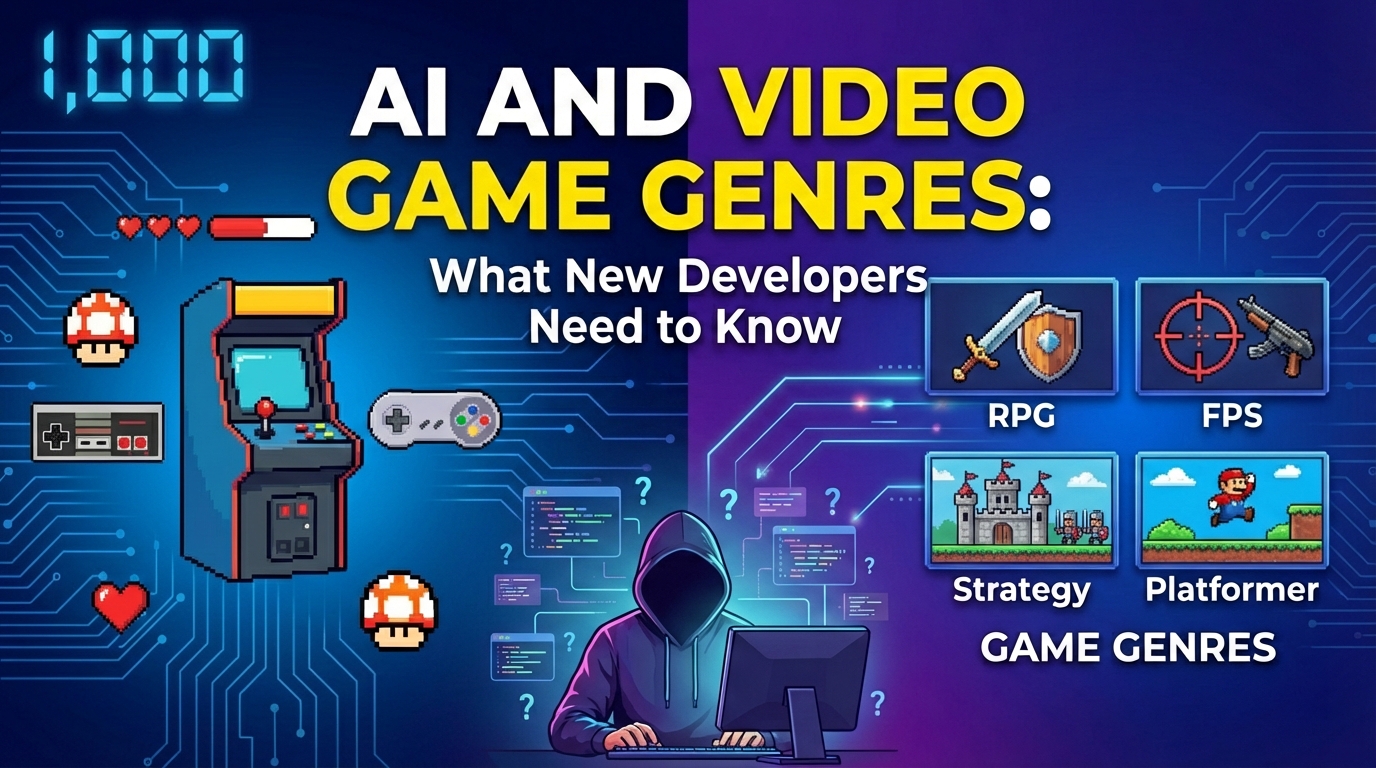
Video game genres definitely exist (there’s a massive list of them) and we use them all the time. But genres can feel confusing fast, because great games often blend multiple ideas. A platformer can become a puzzle game. A deck-builder can feel like a roguelike. An RPG can borrow from life sims.
So why do genres matter at all?
Because for beginners, genres are a shortcut to clarity. They help you decide what to build first, what mechanics you’ll need, and what scope is realistic, especially now that AI tools can generate code, art, dialogue, and systems much faster than before. Learn the most important things to know about how AI can change game development.
Why Genres Matter in Video Game Design
Genres are a way to give order to a messy creative process.
They help you:
- Pick a clear starting point (“I’m making a platformer”)
- Understand what “done” looks like
- Communicate your idea to collaborators (and to AI tools)
- Avoid scope creep by anchoring your first prototype
But genres can also be limiting if you treat them like rules instead of tools. The trick is to use genres to start, then bend them once your core game works.
The Real Beginner Skill: Turning Ideas Into Clear Prompts
In modern game development, especially with AI, results depend heavily on input.
The more clearly you can name what you want:
- mechanics
- camera style
- mood
- progression
- win/lose conditions
…the faster you can build.
Genres give you vocabulary for this. “Metroidvania” communicates exploration + backtracking + ability gates. “Visual novel” communicates branching choices + dialogue + scenes. That vocabulary saves time and reduces frustration.
Best Game Genres for Beginners (And Why)
Here are some beginner-friendly genres that teach core game design skills without requiring massive scope.
1) Platformers: Best First Genre for Learning Fundamentals
Platformers are often the most recommended beginner genre because they teach:
- character movement
- physics and gravity
- collision detection
- level design
- difficulty tuning
The main challenge is balancing difficulty: engaging but not frustrating.
Good next step: once the basics work, add a twist (movement ability, time mechanic, gravity shift, etc.).
2) Puzzle Games: Simple Rules, Deep Design
Puzzle games can be easier to build technically and harder to design well because they depend on clarity and “aha” moments.
They teach:
- player onboarding
- feedback and UI clarity
- pacing and progression
They’re great for small, polished prototypes.
3) Clickers: Fastest Genre to Prototype
Clicker games are perfect for beginners because the core loop is simple:
click → reward → upgrade → repeat.
They teach:
- game loops
- progression systems
- balancing rewards
You can build a playable clicker quickly, then expand it with upgrades, milestones, and effects.
4) Visual Novels: Story-First, Mechanically Light
Visual novels are a great entry point because you can focus on:
- narrative structure
- branching choices
- scene pacing
- UI/UX
AI tools make it easier to generate scenes, dialogue, and even animated visuals, so you can create a playable narrative game faster than ever.
Genres That Are Harder (But Worth It)
Some genres are exciting but more complex for a first project. You can still build them, just start small.
Metroidvania: Powerful, But Planning-Heavy
Metroidvanias add:
- exploration
- interconnected maps
- ability-gated progression
- backtracking and unlocks
They require more planning and asset variety. If you try one early, build a tiny slice: one region, two abilities, one lock, one boss.
RPGs: Asset + Dialogue Heavy (AI Helps a Lot)
RPGs require:
- lots of dialogue
- progression systems
- quests
- items and UI
AI helps enormously with:
- generating dialogue and quests
- creating characters/items/backgrounds
- prototyping combat systems
If you’re new, try an RPG “micro-build”: one town, three NPCs, one quest, one reward.
Simulation Games: Great, But System-Heavy
Sim games can be simple or complex. The risk is building too many systems at once (economy, resources, schedules, AI behavior).
Start with one core mechanic and one loop:
- “Grow plants → sell crops → buy better tools”
or - “Adopt a pet → feed it → unlock new behaviors”
A Simple Way to Choose Your First Game Genre
If you’re stuck, pick your genre based on what you want to practice:
- Want to learn movement + physics? → Platformer
- Want tight design + clarity? → Puzzle
- Want fast results + progression? → Clicker
- Want story + choices? → Visual novel
- Want bigger worlds + growth systems? → RPG (start small)
Then use AI to speed up creation but keep your scope controlled.
How AI Changes Video Game Design for Beginners
AI doesn’t replace game design, it removes friction.
It helps you:
- prototype faster
- generate assets and dialogue
- explore more variations
- iterate without starting over
That means you can start with a genre for structure, then remix it into something original once your foundation works.
Try Video Game Design the Fast Way
If you’re learning video game design, the best method is still the same: build small, test often, iterate.
👉 Try it yourself on Rosebud AI
Start with a genre, describe your idea, and make a playable prototype in minutes.

Andi Bucescu
Andi is the Head of Marketing at Rosebud, where she writes about the intersection of AI, creativity, and brand storytelling. She explores how generative AI is reshaping marketing strategies and creative workflows, with a focus on making complex technology accessible and cutting through the noise of modern campaigns. Her perspective is informed by undergraduate research on effective social media content and consumer psychology.