


New Year Resolutions for 2026: How to Finally Make Real Progress With an AI Game
Every January, millions of people write New Year resolutions with genuine motivation — and by February, most of them are already fading. The problem isn’t discipline or intelligence. It’s how resolutions are framed, measured, and emotionally reinforced.
2026 doesn’t need better motivation. It needs better systems.
This year, the goal shouldn’t be “be better,” “work harder,” or “get in shape.” The goal should be visible, trackable progression, even when motivation dips.
Why New Year Resolutions Usually Fail
Most resolutions collapse for a few predictable reasons:
- They’re too abstract (“be healthier,” “learn more”)
- Progress isn’t visible day to day
- Failure feels final instead of temporary
- There’s no emotional reward loop
Humans don’t improve through willpower alone — we improve through feedback, friction, and small wins.
A Smarter Way to Approach Resolutions in 2026
Instead of asking “What do I want?”, ask:
“What system can I realistically run every week for the next 12 months?”
1. Turn Goals Into Small, Observable Actions
Bad goal: “Learn a new skill”
Better system:
- 20 minutes, 3 times per week
- One concrete output per month (note, sketch, prototype, summary)
Progress should be visible, not theoretical.
2. Design for Low-Energy Days
If your plan only works when you’re motivated, it’s not a real plan.
Ask yourself:
- What’s the minimum version of this habit?
- What still counts as a win on a bad day?
Consistency beats intensity in the long run.
3. Track Progress in a Way That Feels Rewarding
Tracking shouldn’t feel like accounting.
Good tracking:
- Streaks
- Levels
- Badges
- “Before vs After” states
This is where most people fail — and where games outperform notebooks.
4. Make Failure Part of the System
Missing a day shouldn’t feel like breaking the entire resolution.
The rule for 2026:
- Never miss twice
- Recovery is success, not perfection
When failure is expected, people keep going.
Turning New Year Resolutions Into a Mini Game (Using Rosebud AI)
One of the most effective ways to stick to resolutions is to turn them into something playable.
Instead of tracking goals in a spreadsheet, you can create a New Year Resolution mini game for 2026 — where progress feels like leveling up, not self-judgment.
This is exactly the kind of project that works well with Rosebud AI.
The Idea: A “2026 Resolution Game”
Think of it as a personal dashboard that behaves like a game:
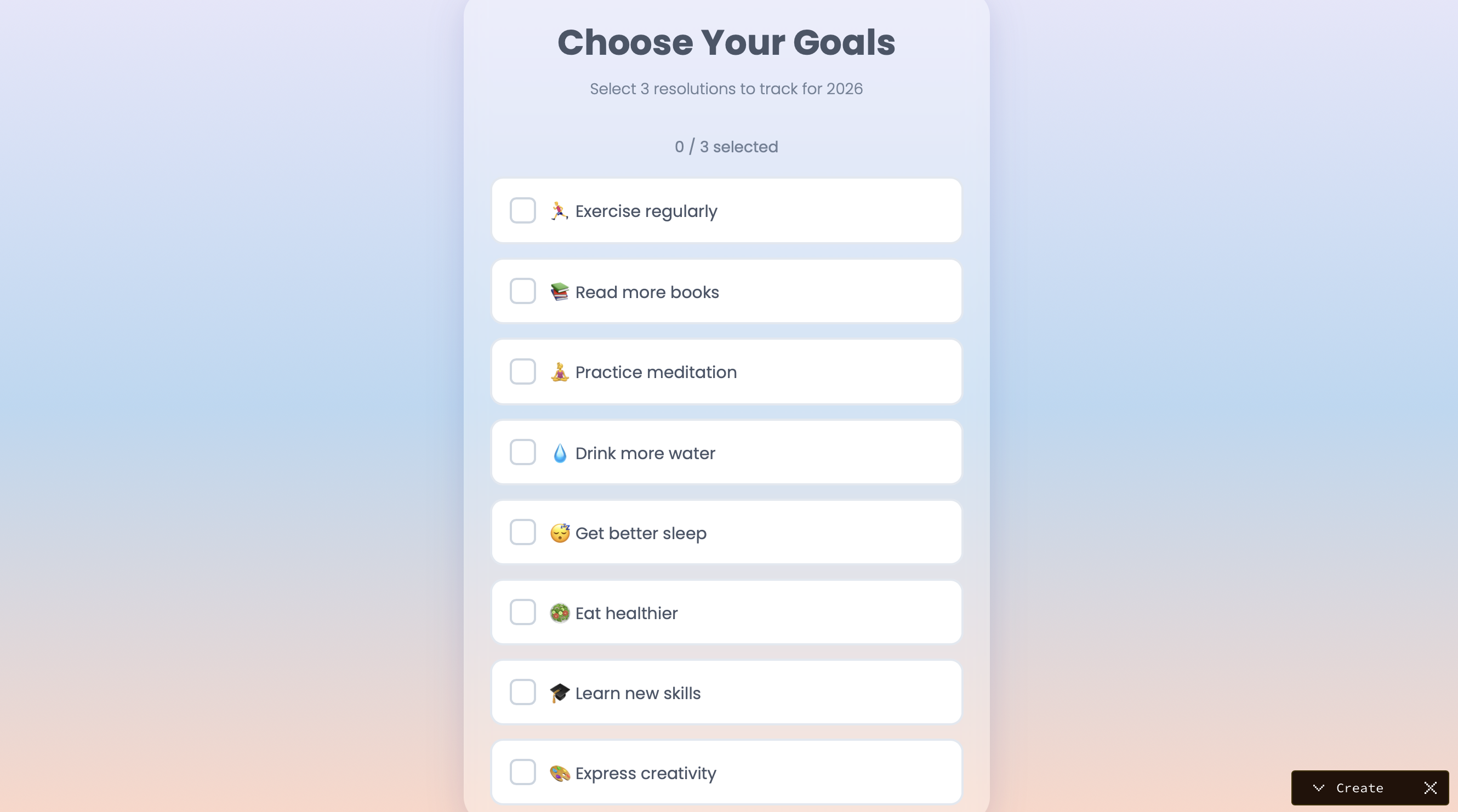
- You choose 1–3 resolutions
- Each resolution becomes a quest
- Daily or weekly actions earn XP
- Missed days don’t reset everything — they slow progress slightly
- Visual feedback shows how far you’ve come in 2026
It’s simple, motivating, and personal.
How to Create the Game with Rosebud AI
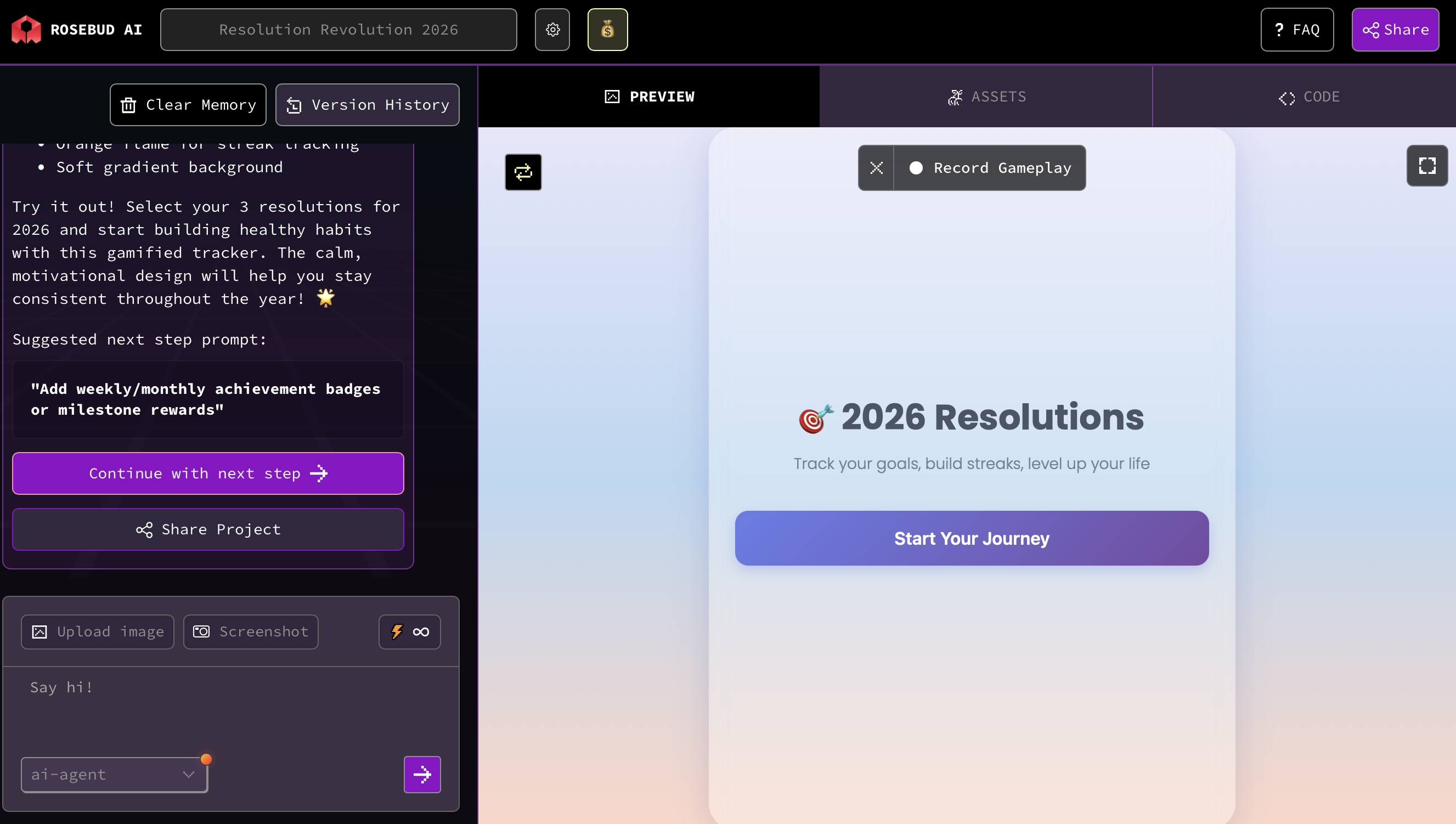
Step 1: Start From the Rosebud Homepage
Go to the creation flow and describe your game in plain language.
Example prompt:
“Create a simple mini game for New Year resolutions 2026. The player selects 3 goals, tracks daily progress, earns XP, and levels up over time. Clean UI, progress bars, streaks, and a calm motivational tone.”
No coding required — just intent and structure.
Step 2: Define the Game Mechanics
Inside the prompt or follow-up instructions, specify:
- XP gained per completed action
- Levels or milestones (Week 1, Month 1, Quarter 1)
- Visual progress indicators (bars, badges, calendar view)
This transforms abstract self-improvement into clear game logic.
Step 3: Personalize the Experience
You can make the game:
- Solo (personal tracker)
- Social (share progress with friends)
- Seasonal (special milestones for March, June, September, December)
You’re not just tracking habits — you’re building a year-long progression arc.
Step 4: Iterate as the Year Evolves
The best part: your game can change in 2026.
- Add new goals mid-year
- Adjust difficulty
- Introduce “recovery weeks”
- Reset streak penalties without losing progress
This mirrors real life far better than rigid planners.
Why This Works Better Than Traditional Resolutions
Games succeed where resolutions fail because they:
- Make progress visible
- Normalize failure
- Reward consistency
- Reduce emotional pressure
- Turn effort into feedback
When self-improvement feels like play, people stay longer.
Final Thought: Treat 2026 Like a Long Game
2026 isn’t about a perfect January.
It’s about running a system for 12 months.
If your resolution strategy feels heavy, it won’t last.
If it feels playable, adjustable, and rewarding — it will.
And sometimes, the smartest resolution is not trying harder…
but designing a better game to play.

Patrick Moumiet
Patrick is a marketer at Rosebud with a background as a content creator and social media strategist. He has launched courses and coaching programs in social media marketing and content creation, coaching 500+ large-scale influencers customers. On the Rosebud blog, he writes about consumer AI and how to make money with AI, exploring ways to combine state-of-the-art models with Rosebud’s creative tools.