


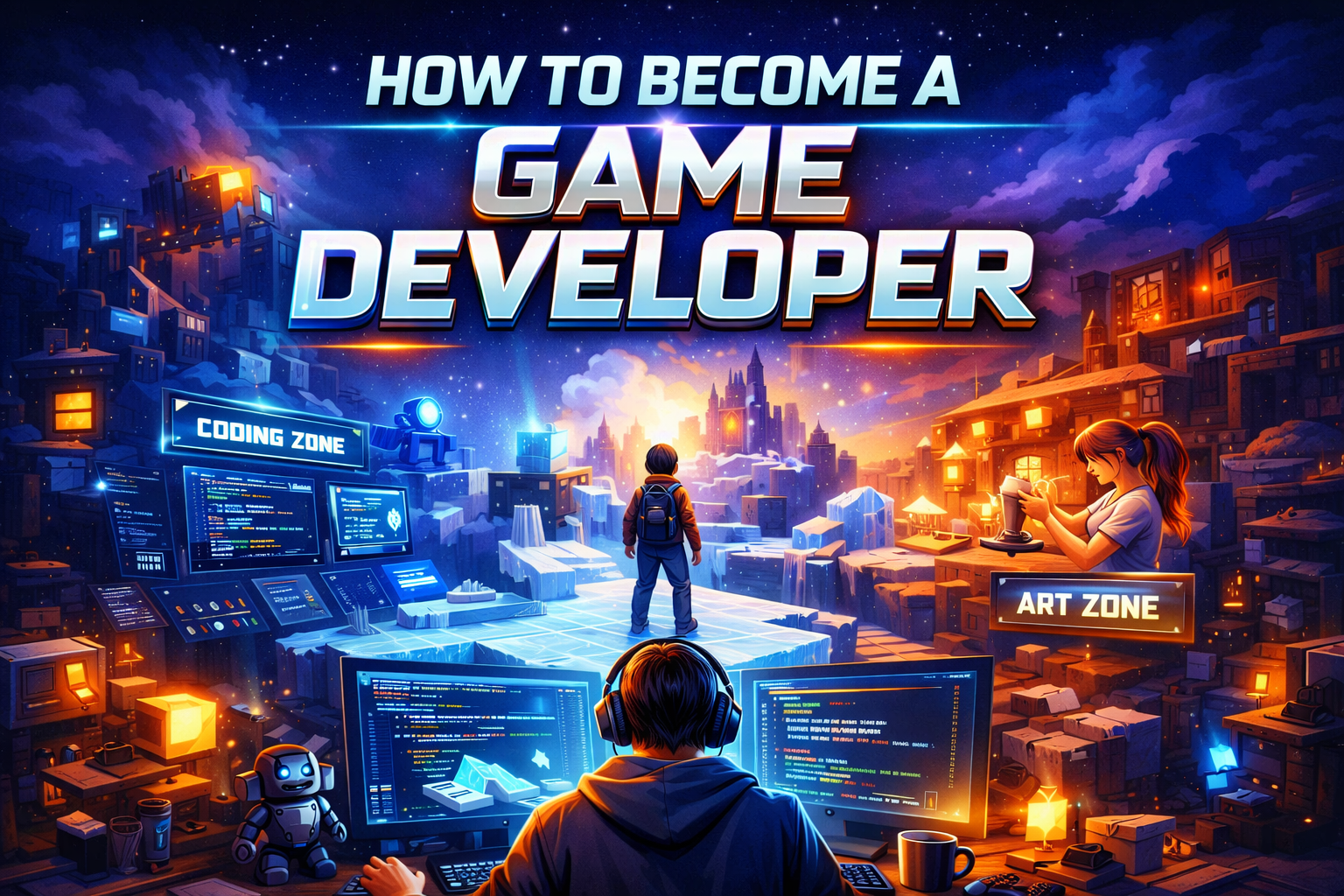
How to Become a Game Developer (The Modern Way)
Becoming a game developer used to feel intimidating. You were expected to learn programming, master an engine, understand math, design systems, and only then try to make something fun.
That path still exists — but it’s no longer the fastest, nor the most effective.
Today, the most successful new developers learn by building first, experimenting early, and understanding games as living systems rather than academic subjects. Game development is not something you study once and apply later. It’s something you grow into by creating, breaking, and refining.
This article shows a modern path to becoming a game developer: one that combines mindset, experimentation, and AI-assisted creation — while still teaching you real skills.
Part 1 — Learning to Think Like a Game Developer
Most beginners make the same mistake: they believe they must be ready before they start. They wait to finish tutorials, memorize syntax, or fully understand an engine before attempting a real game.
Professional game developers do the opposite. They start with incomplete knowledge and let the project teach them what they need next.
A game developer doesn’t think in terms of “features first.” They think in terms of systems. Even the simplest game is a network of rules interacting with each other: movement affects challenge, challenge affects emotion, emotion affects motivation.
Over time, you begin to see patterns everywhere. Racing games, platformers, RPGs, and simulations all rely on similar loops — only the surface changes. Once you recognize this, every game you play becomes a lesson.
The fastest progress happens when you adopt a hacker-style approach to learning. Instead of asking “Do I understand this?”, you ask “What happens if I change this?” You tweak values, alter rules, break mechanics, and observe the results. Understanding emerges naturally from experimentation.
This mindset is the foundation of real game development skill.
Part 2 — Learning by Building with Rosebud AI
This is where modern tools change everything.
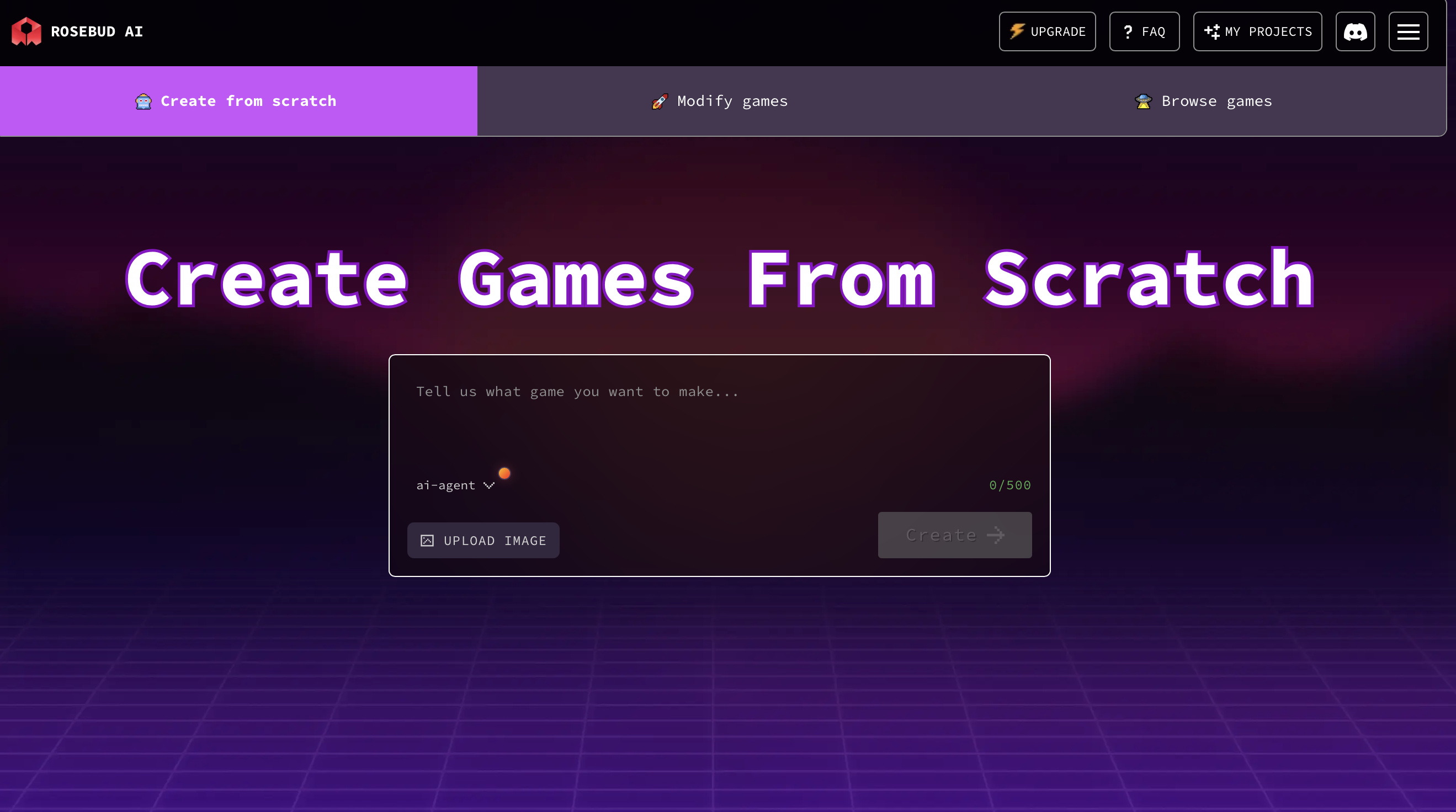
With Rosebud AI, you don’t begin with an empty project or boilerplate code. You begin with intent. You describe the type of game you want to make, the mood, and the core idea — and the system generates a playable game for you.
That game isn’t a fake prototype. It contains real logic, real systems, and real code.
What makes this powerful for learning is not just speed — it’s context. Instead of learning abstract concepts in isolation, you explore them inside a functioning game. Mechanics already exist. Systems already interact. Your job is to understand them by interacting with them.
The most important learning happens in the code tab. This is where the game stops being magic and starts being understandable. You can read how movement works, how interactions are handled, and how progression is structured.
You don’t need to rewrite everything. In fact, you shouldn’t. The real learning loop looks like this:
You change one small thing, play immediately, and feel the difference. Then you repeat. Over time, you begin to recognize patterns. You start writing your own functions. You replace parts of the generated logic with your own ideas. Eventually, the game feels like yours.
This is how developers actually learn in the real world — by modifying existing systems until they fully understand them.
Part 3 — The Meta Game: A Game About Becoming a Game Developer
The example game you build follows a meta idea: the game itself is about becoming a game developer.
In this game, the player controls a developer inside a 3D world. The world represents learning and creation. Coding, art, and design are not menus — they are physical spaces the player explores.
Different areas of the world focus on different aspects of development. One zone teaches logic and mechanics. Another focuses on visuals and feedback. Another explores game design and player experience. Progression is tied to understanding, not completion.
Ice is used as a symbolic mechanic throughout the world. Frozen areas block progress, representing confusion or incomplete understanding. As the player tweaks code and modifies systems, the ice melts. Slippery surfaces reflect unstable mechanics. Stability comes from refinement.
There is no traditional “win” state. The final goal is creation itself. By the end, the player builds a new game inside the game, using the systems they’ve learned to manipulate.
The player doesn’t just finish the game — they become a game developer.
Example Prompt for the Game (Copy-Paste Ready)
Here is a clean, practical prompt you can use directly in Rosebud AI to generate the example game described above:
Prompt:
Create a 3D exploratory game called How to Become a Game Developer. You play a developer in a stylized world split into coding, art, and design zones, where systems are learned through play. Coding uses an ice metaphor: frozen paths block understanding, melting ice shows progress, slippery ice reflects unstable logic. Players tweak mechanics in a code tab and see instant world changes. The goal isn’t winning—but building a new playable game through experimentation and exploration.
Final Thoughts
Becoming a game developer today is no longer about waiting until you know enough.
It’s about:
- Building early
- Learning through experimentation
- Tweaking real systems
- Letting curiosity guide you
With tools like Rosebud AI, the barrier to entry disappears — but the depth remains. You still learn real mechanics, real logic, and real design thinking. You just learn them in a more human way.
That’s the modern path to becoming a game developer. 🎮

Patrick Moumiet
Patrick is a marketer at Rosebud with a background as a content creator and social media strategist. He has launched courses and coaching programs in social media marketing and content creation, coaching 500+ large-scale influencers customers. On the Rosebud blog, he writes about consumer AI and how to make money with AI, exploring ways to combine state-of-the-art models with Rosebud’s creative tools.