


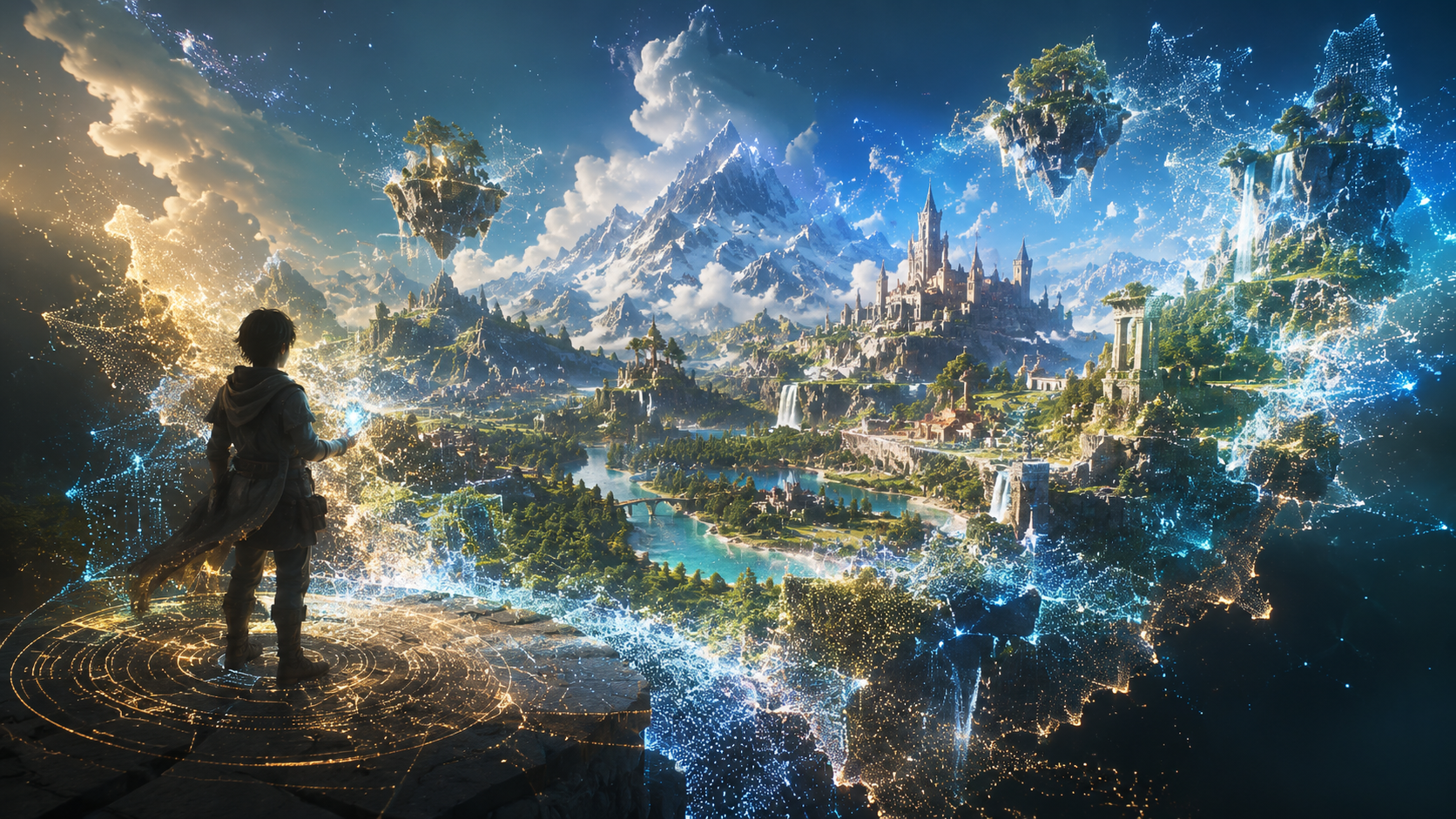
What "generative 3D worlds" actually means
For most of game history, building a 3D environment meant modeling geometry, painting textures, and lighting a scene by hand. Generative world models flip that: you describe a place — or hand the model an image or panorama — and it produces a full, explorable 3D space in minutes. Instead of a single object, you get an entire environment you can move a camera through.
The two ways these worlds are represented
Gaussian splats — the highest-fidelity option. A scene is stored as millions of soft, semi-transparent particles, capturing soft lighting and reflections that traditional meshes struggle with. Splats render right in the browser (via open renderers like Spark on THREE.js), which makes them a natural fit for web-based games.
Triangle meshes — the classic format game engines expect, often shipped with a separate collider mesh for physics. Lower fidelity than splats, but universally compatible.
Where generative worlds fit in a game pipeline
A world model gets you the setting fast. What it doesn't give you is the game — movement, objectives, interaction, multiplayer. That's the gap Rosebud fills: you bring a generated world in, add gameplay with natural language, and publish something playable in the browser. Generate the world, add the game, share the link.
Tools in this space
The leading generative world model right now is Marble, from World Labs — covered in depth in our guide to what Marble is and how it works. Once you have a world, here is how to turn it into a playable game in Rosebud.
See it in action: Marble-powered games on Rosebud
.png)
Want proof? These browser-playable Rosebud games were all built on Marble-generated 3D worlds — jump in and explore:
Vaporwave Adventure: Temple of 3DGS — explore a dreamlike temple built from Gaussian splats, running right in your browser.
Pumpkin Says — a Simon-Says-style party game set inside a generated 3D scene.
Squid Game Multiplayer Obby — a multiplayer obstacle course set in a Marble-generated world.
Frequently asked questions
Can you play a generative 3D world as a game? Not on its own — a world model produces the environment; you add the gameplay in a platform like Rosebud.
Do generative worlds run in a browser? Gaussian-splat worlds do, via THREE.js-based renderers, which is why they pair so well with web games.
Do I need to know 3D modeling? No — describing the world in words or handing over an image is enough.
Ready to turn a generated world into a game? Create one in Rosebud.

Andi Bucescu
Andi is the Head of Marketing at Rosebud, where she writes about the intersection of AI, creativity, and brand storytelling. She explores how generative AI is reshaping marketing strategies and creative workflows, with a focus on making complex technology accessible and cutting through the noise of modern campaigns. Her perspective is informed by undergraduate research on effective social media content and consumer psychology.